Labels

Showing posts with label Medical Education. Show all posts

Thursday, March 22, 2012

Match Results Are In

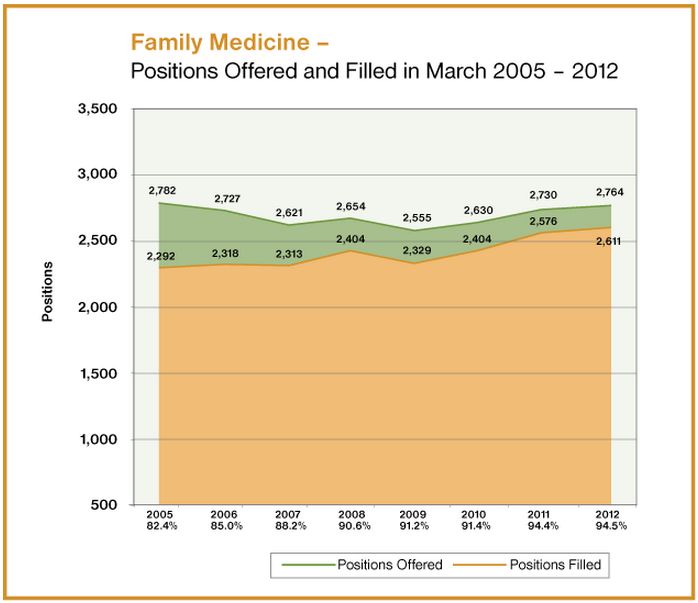
Last Friday, graduating medical students across the country received their residency match results. For the third straight year, there has been an increase in the number of students matching into family medicine. This year 94.5% of all family medicine spots were filled and the total number of U.S. grads entering the field in 2012 is 1,335. This is an increase in 18 seniors compared to 2011. Family Medicine added 34 new residency positions this year and 35 more total students (U.S. + non-U.S. grads) entered the field compared to 2011.

Although the numbers are increasing, I hope to see further increases in the years to come. The rate of new family doctors is not keeping pace with demand and there needs to be a much larger bump in these numbers in 2013 and the following years in order to effectively serve the population's health needs.

Image from aafp.org

Wednesday, March 21, 2012

Duke's Primary Care Leadership Track

Future primary care providers will work in patient centered medical homes (PCMHs). This new model of care will be different than traditional practice models. Primary care physicians will work in inter-disciplinary teams, be expected to coordinate and integrate care with others in the medical neighborhood, and they will be held accountable for the quality of care provided to patients. Medical schools are responding by implementing programs and special tracks to prepare medical students to work in these innovative practice models.

One of the best examples nationally is Duke University School of Medicine's Primary Care Leadership Track (PCLT). Applicants to Duke's program apply specifically to the PCLT and this year alone they received well over a hundred applications. The PCLT works to develop students into national leaders in primary care.

The first year of medical school is largely the same in that students in the PCLT spend the majority of their time studying the basic sciences. At the end of their first year, they take their step 1 exams and immediately move into a longitudinal clerkship experience.

Students spend about 80 percent of their time in the outpatient setting alternating clinic days between medical practices. For example, every Monday a student will go to an internal medicine clinic, Tuesday she will go to her Family Med Clinic, Psychiatry on Wednesday, and Pediatrics on Thursday. This provides the students with continuity of care within each of the core disciplines and gives them a chance to follow their patients' care over the course of a year.

Students also are assigned to a panel of about 20 patients who they follow throughout the entire year. Every time one of the patients in their panel has a medical appointment, surgery, emergency department visit, or baby delivery, the student is expected to be there with the patient. This provides students with the unique insight of how patients flow through the medical system.

Within the PCLT curriculum, students go through a PCMH mini-course. The mini-course is designed to teach students the core values of primary care and PCMHs. Students are then engaging in medical practices who are working towards PCMH accreditation by taking on an innovation projects. A good example of a project is when one student worked with a clinic to meet phone call back goals. The student tracked the average length of time it took the clinic to call their patients back and then he worked with the clinic to shorten the interval. Other projects have looked at follow up rates and length of time from the point of hospital discharge, quality metrics for diabetic patients, and rate of specialist to primary care provider communication after the patient sees their specialist physician.

Engaging students in innovation projects is developing strong leadership skills and showing students the inner workings of this new model of care. Students will be ahead of their peers once they start practicing as they will have real life experience in improving practice models which are truly patient-centered.

Duke's focus on primary care is inspiring and they are setting the bar for preparing and producing future leaders in primary care medicine.

Thursday, March 8, 2012

Emphasizing Primary Care in Medical Education: Utah's Primary Care Track

Medical schools across the country are implementing exciting and innovative curricular reforms to promote and encourage students to pursue primary care medicine, but the University of Utah School of Medicine is in a crowd of their own. Utah has created a primary care track for medical students interested in family medicine, pediatrics, or internal medicine. They start developing leaders in primary care as early as the first few weeks of medical school.

During the first two years of medical school, which are focused on basic science, Utah has found a way to better incorporate primary care values into their students' experience. First year students work as a medical assistant in a local clinic during their orientation month generating a better appreciation for the work that others on the medical team perform. Additionally, first year students work in a longitudinal clinic that they go to for a half day every other week. Continuity of care is a core value of all primary care, so Utah is exposing students to this important aspect of the field early. Also, during the first couple years, strong focus is put on clinical and communication skills.

Utah is alone in how they utilize the fourth year of medical school to better prepare students for their first day as a primary care intern. The curricular reform was derived from a need to make fourth year more productive and useful for students. The fourth year is broken into four components: longitudinal course, 4 week module, continuity care clinics, and teaching.

In the longitudinal component, all students in the primary care track spend a half day together, two times per month. Each longitudinal session is focused on an important issue or skill needed by primary care doctors. Some topic examples include communication, team building, ethics, public health, health reform, and health systems. The students have specific assignments during each of these sessions to tie it back into the rotation that they are currently on. For example, if a student is doing a cardiology rotation, they will have an assignment to bring in the primary care issue being discussed to that rotation. It is a way to make each fourth year rotation pertinent to primary care.

The four week module is a more intensive time to hone skills that are specifically needed by interns. They review note writing and see a lot of standardized patients to develop important technical and interpersonal skills.

The continuity care patient experience is the most exciting aspect of the primary care track. Towards the end of their third year, students recruit a panel of patients who they will track the entire year. Every time a patient on their panel has an appointment -- whether the appointment is for surgery, delivery, primary care, oncology, etc. -- the student accompanies them and serves as their health advocate. This experience shows students the inner workings of the U.S. health system firsthand, but also provides a valuable asset to patients. Having a medical professional present who knows your medical history inside and out improves care and outcomes. Kinks are still being worked out with this aspect of the track, but the idea is innovative and a very important component of their curriculum.

Lastly, the students in the primary care track have obligations to teach second year medical students. Primary care doctors need teaching skills for their patients and future medical trainees, so this is a time to develop those while reviewing important science knowledge and technical skills.

Utah is ahead of the crowd in terms of creating an innovative, primary care centered medical curriculum. It will be worth keeping tabs on how this program continues to develop.

Saturday, January 28, 2012

Why are Students Shying Away from Primary Care?

Primary care in the United States is in a state of crisis. Fewer medical school graduates than ever are choosing primary care as their specialty. The American Academy of Family Physicians (AAFP) states that there has been a 51.8 percent decrease in graduates going into primary care since 1997. With the current trajectory, this will leave the country with a shortage of 40,000 primary care physicians by 2020. Couple this with the aging baby boomer population and the system may crumble all together. It is universally accepted that primary care is the backbone of the health care system. It is these providers who serve as the gatekeepers into the system and are ultimately charged with protecting the overall health of individuals and the population.

Drs. Bach and Kocher make the argument that large medical school debt is pushing students into more lucrative fields to pay back their loans as quickly as possible. Their solution is to make medical school free, but then charge people for specialty training. They believe that this would incentivize students away from sub-specialization. As a medical student who will accumulate around $200,000 of debt to be educated (and who is married to a medical student with similar school loans), I clearly understand the financial constraints that this places. However, debt is only a portion of the entire story for why students are not choosing primary care fields. By putting all our focus on the debt issue, it will distract us from finding the real reasons why students are not going into primary care.

Medical students are not exposed to the wonderful sides of primary care medicine. In a general medical practice, the problems are often complex and the solutions are challenging, so it takes months or even years to attack the issues effectively. Students come in and out of primary care services on a month-by-month basis, so seeing any long term solutions to improving and promoting overall health is nearly impossible. Also, primary care physicians across the country are seeking innovative ways to improve patient care. This work is exciting, intellectually demanding, and extremely difficult to implement. We do not get exposed to this aspect of care because often times these projects take years to develop. Another issue is that in the academic setting, primary care is highly disrespected. This should not be that surprising considering academic centers are filled with super sub-specialists who do not fully appreciate how difficult it is to care for the whole patient, rather than a small part. Lastly, primary care, at its core, is about relationships. By being placed temporarily on a service, any relationships formed are superficial and casual.

Focusing solely on debt is a flawed solution. There are many programs for loan-forgiveness if students go into primary care fields. The debt argument looks dramatic on paper, but the real issues for why students are not going into the field are much deeper. Those are the areas on which we need to focus our attention; provide students with the chance for continuity of care, involve them in clinical innovations, and show them firsthand that the field is respectable and worth pursuing.

BWC

Response to Op-Ed: http://www.nytimes.com/2011/05/29/opinion/29bach.html?_r=2

Monday, November 7, 2011

Innovation in Physician Training

Patient-Centered Medical Homes (PCMH’s) are presented as a care delivery innovation that has had success in the realm of increasing quality of care while decreasing costs. At its core, the PCMH seeks to strengthen primary care, leading to coordinated care, improved access, and ultimately reduced costs. However, the dark irony of the success of the PCMH model is that as primary care demonstrates its ability to serve as a hub for care coordination while reducing cost, primary care physicians (PCP’s) are dwindling in proportion of the physician work force. Perversely designed fee schedules have created a dramatic income inequality among physician specialties, strongly steering medical students away from generalist careers. While many factors ultimately influence student specialty choice, medical students are hard pressed to choose generalist careers while income disparity remains so troublingly wide.

Further, essential to the success of PCMH’s are functional teams. Looking at the results of the 2006 Group Health Cooperative model, strong PCP leadership was identified as a critical factor for the success of organization transformation into a PCMH[1]. However, current undergraduate and graduate medical training does not search out these skills in its applicants, nor does it provide comprehensive education for how to develop these practice tools. Strong leadership capable of excelling at the challenges of practice management are necessary for PCMH’s to become a widespread national success story, yet medical education has not responded to the growing need for these additional physician skill sets. Biomedical science training and clinical knowledge, the current mainstay of medical education, is not enough to produce physicians competent for current health challenges. Physicians, especially PCP’s, must be taught how to work and lead within teams, manage practices, motivate members of the care team, integrate health IT, and adapt quickly to practice innovations. These competencies are critical for the success of PCMH’s and ultimately care delivery transformation.

The reported success of PCMH’s is exciting; though many details need to be ironed out to rigorously define the characteristics of successful models, the early victories among differing patient populations provide evidence that the key organizing principles of the PCMH are widely applicable across our nation. However, to achieve this dream of coordinated, high value care, it is necessary to rethink medical student training and physician payment. Large income disparities are not sustainable if we are to attract the number and quality of primary care doctors necessary to lead transformation in care delivery. Further, medical education itself must innovate in order to equip its graduates to practice within these new models.


[1] Robert J. Reid, Katie Coleman, Eric A. Johnson, Paul A. Fishman, Clarissa Hsu, Michael P. Soman, Claire E. Trescott, Michael Erikson and Eric B. Larson The Group Health Medical Home At Year Two: Cost Savings, Higher Patient Satisfaction, And Less Burnout For Providers Health Affairs, 29, no.5 (2010):835-843