We are happy to announce that the authors of Primary Care Breakfast Club published a perspective piece in the New England Journal of Medicine on September 6, 2012. Our piece, titled "The Developing Vision of Primary Care", has received a lot of feedback from all sides. If you are interested in continuing the conversation, feel free to leave a comment.
To read the piece, visit the following link: http://www.nejm.org/doi/full/10.1056/NEJMp1204487
We hope you enjoy and would love to hear your feedback!

Showing posts with label Family Medicine. Show all posts
Showing posts with label Family Medicine. Show all posts
Saturday, October 27, 2012

Tuesday, May 1, 2012
Primary Care Spring
IBM is launching what they are calling the "Primary Care Spring." At the risk of upstaging Occupy Spring they are seeking to revolutionize the way they take care of their employees by widely promulgating the Patient Centered Medical Home (PCMH). They are certainly not the first, but they represent a growing number of large insurers that have jumped on the wagon.
In a YouTube video presentation by Dr. Paul Grundy of IBM that can be found at the above link he describes 3 trends he is seeing:
1. Cost: good comprehensive coordinated patient-centered care saves money
2. Data: we can now help physicians make better clinical decisions because we now have the data needed to do so (how could he give a presentation without mentioning "Watson"?)
3. On-line asynchronous care: medical homes succeed because they allow for on-line and asynchronous care where you don't have to see your doctor to be treated and they don't have to see you to get paid. In this new information age our children will not put up with receiving care any other way.
In short, this is nothing new but it is all coming together across the country. The government, insurers, employers, providers, and patients are all recognizing that accessible, coordinated, patient-centered care really does save money and make people healthier.
You CAN have your cake and eat it too.
-JKR
In a YouTube video presentation by Dr. Paul Grundy of IBM that can be found at the above link he describes 3 trends he is seeing:
1. Cost: good comprehensive coordinated patient-centered care saves money
2. Data: we can now help physicians make better clinical decisions because we now have the data needed to do so (how could he give a presentation without mentioning "Watson"?)
3. On-line asynchronous care: medical homes succeed because they allow for on-line and asynchronous care where you don't have to see your doctor to be treated and they don't have to see you to get paid. In this new information age our children will not put up with receiving care any other way.
In short, this is nothing new but it is all coming together across the country. The government, insurers, employers, providers, and patients are all recognizing that accessible, coordinated, patient-centered care really does save money and make people healthier.
You CAN have your cake and eat it too.
-JKR
Thursday, March 22, 2012
Match Results Are In
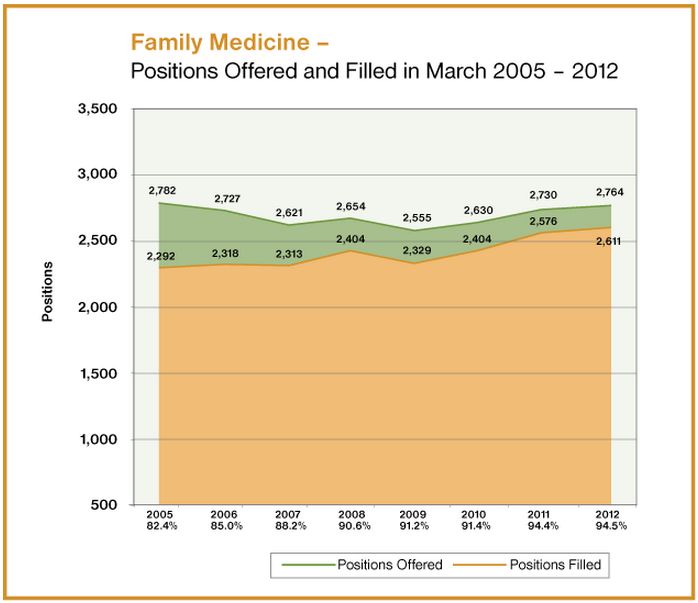 Last Friday, graduating medical students across the country received their residency match results. For the third straight year, there has been an increase in the number of students matching into family medicine. This year 94.5% of all family medicine spots were filled and the total number of U.S. grads entering the field in 2012 is 1,335. This is an increase in 18 seniors compared to 2011. Family Medicine added 34 new residency positions this year and 35 more total students (U.S. + non-U.S. grads) entered the field compared to 2011.
 Although the numbers are increasing, I hope to see further increases in the years to come. The rate of new family doctors is not keeping pace with demand and there needs to be a much larger bump in these numbers in 2013 and the following years in order to effectively serve the population's health needs.
Image from aafp.org
Subscribe to:
Posts (Atom)